
 English
 Español
 عربى
عربى Français
 italiano
 Deutsch
Content
- 1 A Newly Completed Bronze Angel Sculpture Showcases Traditional Craftsmanship
- 2 Large Wings Create the Visual Focus of the Sculpture
- 3 Natural Clothing Folds Add Depth to the Figure
- 4 Hot Coloring Transforms the Cast Bronze Surface
- 5 Hand Polishing Refines the Details After Casting
- 6 Three-Dimensional Quality Is Visible from Every Angle
- 7 Why Cast Bronze Works Well for Outdoor Sculpture
- 8 From Custom Design to Finished Sculpture
- 9 Bronze Sculpture Manufacturing for International Projects
- 10 Craftsmanship Remains Important in Large-Scale Bronze Art
- 11 Industry Knowledge: What Determines the Quality of a Cast Bronze Sculpture?
A Newly Completed Bronze Angel Sculpture Showcases Traditional Craftsmanship
A newly completed cast bronze angel sculpture has recently emerged from the finishing process at the Xinyesheng Sculpture factory, offering a close look at the craftsmanship behind a large-scale custom metal artwork. The production video records the final stages of hot coloring and surface treatment, highlighting how an initially cast bronze form is transformed into a refined sculpture with a rich antique bronze appearance.
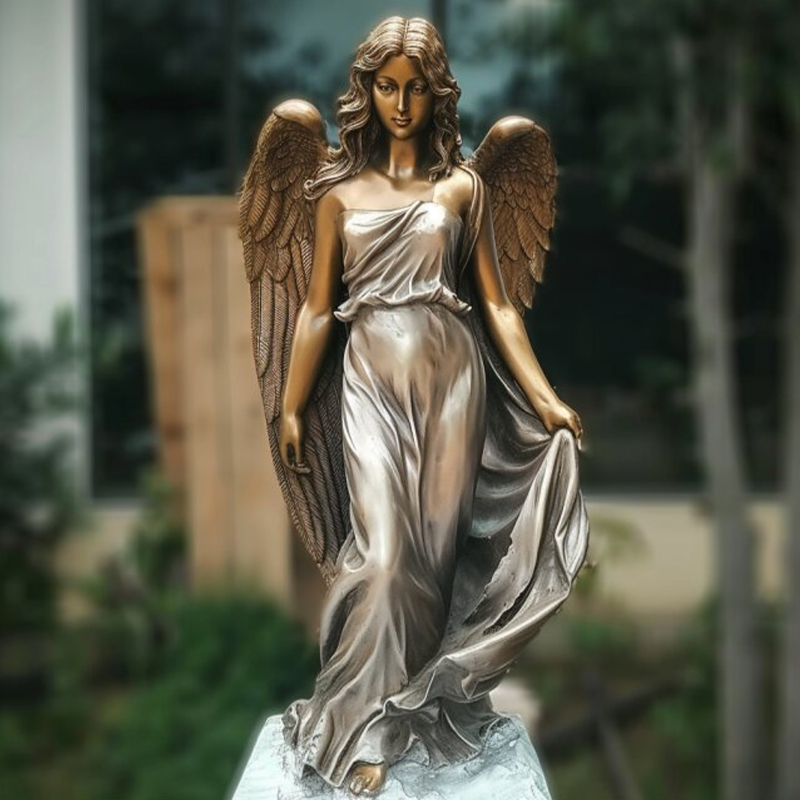
The completed angel features an impressive pair of large wings, carefully modeled feathers, flowing garments, and a serene standing posture with hands held together in a prayer-like gesture. From the front, side, and rear views, the sculpture demonstrates how much attention is given to three-dimensional modeling and surface detail. The finished antique bronze tone further emphasizes the depth of the sculpted forms, particularly across the wings, facial features, clothing folds, and lower garment.
For outdoor sculpture projects, appearance is only one consideration. Material durability, finishing quality, and resistance to changing environmental conditions are also important. Cast bronze is widely used for public art, memorial sculpture, religious sculpture, gardens, estates, and architectural landscapes because it combines artistic versatility with strong outdoor performance.
Large Wings Create the Visual Focus of the Sculpture
The most immediately recognizable feature of this angel sculpture is its large pair of wings. The wings extend outward from the figure and create a strong symmetrical silhouette, giving the sculpture a sense of movement and visual grandeur while the central figure remains calm and composed.
Each wing contains numerous individual feather forms. Instead of presenting the wings as a flat surface, the sculptural modeling creates different levels of depth between the feather layers. This allows light to interact with the surface from different angles and makes the wings visually effective when viewed from the front or side.
The rear view is equally important because the wings are not treated simply as decorative elements attached to the front-facing figure. Their structure, feather patterns, and connection to the body are developed as part of the complete three-dimensional composition. This is particularly valuable for sculptures installed in open spaces where visitors may walk around the artwork.
Natural Clothing Folds Add Depth to the Figure
Another important detail is the treatment of the angel's clothing. The long robe is modeled with numerous natural folds that follow the posture and movement of the body. These folds create alternating areas of highlights and shadows, giving the garment a realistic sense of weight and volume.
The lower portion of the robe also demonstrates the importance of hand finishing in large-scale sculpture. Rather than relying only on the original casting surface, artisans refine the transitions between different forms and polish selected areas to improve the visual relationship between raised and recessed details.
The sleeves and upper garment are similarly shaped to create flowing lines around the arms and torso. When combined with the praying hands and calm facial expression, these details contribute to the symbolic and solemn character commonly associated with angel sculptures.
Hot Coloring Transforms the Cast Bronze Surface
One of the key stages shown in the production video is the hot coloring treatment. After the bronze sculpture has been cast and prepared, artisans apply controlled heat and coloring materials to develop the desired surface appearance.
Bronze coloring is more than simply adding a uniform layer of color. The treatment can be adjusted according to the shape and texture of the sculpture. Recessed areas can retain darker tones, while raised details can be brought forward through polishing and controlled finishing. This creates visual contrast and helps reveal the underlying sculptural modeling.
For this angel sculpture, the selected finish develops a vintage antique bronze appearance. The darker and lighter areas across the wings, robe, and body help emphasize the detailed modeling while giving the entire sculpture a classical character.
Because bronze surfaces respond differently according to temperature, treatment time, surface preparation, and the materials used during coloring, experienced artisans play an important role in achieving a consistent final appearance. The process requires observation and adjustment rather than simply following a single mechanical coating procedure.
Hand Polishing Refines the Details After Casting
Bronze casting creates the basic three-dimensional form, but the casting stage is not the end of the manufacturing process. After casting, the sculpture normally requires additional work to remove imperfections, refine surfaces, improve transitions, and prepare the artwork for its final finish.
In the production shown in the video, manual work remains an important part of the finishing process. Artisans work across different sections of the sculpture to improve the surface and preserve the character of the original design. This is especially important around highly detailed areas such as individual feathers, facial features, fingers, garment folds, and decorative transitions.
Hand polishing also allows the finishing team to control how different parts of the sculpture reflect light. A completely uniform surface could reduce the visual depth of a highly detailed sculpture. Selective polishing and coloring can instead create a layered appearance in which raised details appear brighter and recessed areas remain deeper.
Three-Dimensional Quality Is Visible from Every Angle
A large outdoor sculpture must be considered from more than one viewing direction. The completed angel sculpture is therefore presented from multiple angles, allowing the front, side, and rear details to be examined.
The frontal view emphasizes the symmetrical wings, facial expression, hands, and long robe. From the side, the projection of the wings and the depth of the body become more apparent. The rear view highlights the construction and feather modeling of the wings while demonstrating that the sculpture has been developed as a complete three-dimensional artwork.
This multi-angle approach is particularly important for sculptures intended for plazas, gardens, estates, campuses, and other open environments. Visitors may approach the artwork from different directions, so a well-designed sculpture should maintain visual quality throughout its entire form.
Why Cast Bronze Works Well for Outdoor Sculpture
Cast bronze is a long-established material for outdoor sculpture because it provides a useful combination of strength, detail reproduction, and weather resistance. It can be cast into complex forms while retaining relatively fine surface details, making it suitable for figurative works, religious sculptures, monuments, decorative statues, and large custom artworks.
For outdoor applications, the natural development of a bronze surface can also become part of the artistic character of the sculpture. With appropriate finishing and maintenance, bronze can maintain its visual appeal while developing a distinctive surface appearance over time.
This makes bronze suitable for environments such as outdoor public squares, landscaped parks, private estates, gardens, institutional campuses, religious sites, and memorial spaces. The material can also be customized through different surface treatments to match the architectural style and visual requirements of a particular project.
From Custom Design to Finished Sculpture
The completed angel statue also reflects the broader workflow required for a custom sculpture project. A successful large-scale artwork begins with an appropriate concept and three-dimensional design. The sculptural form must then be translated into a manufacturable structure before casting, assembly, surface refinement, coloring, and final inspection.
Xinyesheng Sculpture is a China-based sculpture manufacturer and custom design metal statue supplier with 13 years of experience in sculpture creation. Its R&D and design team has more than a decade of experience and works across stainless steel mirror-finish sculptures, marble works, weathering steel pieces, bronze casting, and tombstone artistry.
The company integrates design, production, installation, and after-sales service into a complete project process. This integrated approach allows custom sculpture projects to move from an initial concept through manufacturing and finishing while maintaining communication between design and production teams.
Bronze Sculpture Manufacturing for International Projects
Xinyesheng Sculpture has developed production capabilities for a range of customized sculpture applications. Its work has been supplied to projects in different international markets, including European public squares, North American campuses, religious sculpture projects in Asia, and memorial art projects in Africa.
Such projects often require more than standard decorative products. The dimensions, surface treatment, structural requirements, installation conditions, and artistic style may all vary according to the project. Custom manufacturing therefore provides greater flexibility for clients looking for sculptures that fit a particular site or architectural environment.
European-style bronze sculptures, religious figures, memorial statues, garden sculptures, and large public artworks can all be developed according to project requirements. Material selection and finishing can also be adjusted to create different visual effects, from traditional antique bronze to more contemporary surface treatments.
Craftsmanship Remains Important in Large-Scale Bronze Art
The completion of this bronze angel sculpture demonstrates that large-scale sculpture production combines industrial manufacturing capabilities with detailed manual craftsmanship. Casting provides the durable bronze structure and reproduces the overall form, while grinding, polishing, detailing, and hot coloring determine much of the final visual quality.
The large wings, layered feathers, natural robe folds, facial details, and antique bronze finish all contribute to the final character of the artwork. More importantly, the multiple viewing angles show that the sculpture has been developed as a complete three-dimensional piece rather than a decorative front-facing object.
For outdoor plazas, gardens, estates, campuses, memorial spaces, and other landscape projects, a custom cast bronze angel sculpture can provide both symbolic meaning and a strong architectural presence. With experienced design, casting, finishing, and installation support, bronze remains a versatile material for creating durable and visually distinctive public and private artworks.
Industry Knowledge: What Determines the Quality of a Cast Bronze Sculpture?
The quality of a cast bronze sculpture is influenced by several interconnected factors. The original design determines the proportions and level of detail. The casting process determines whether the complex forms can be reproduced accurately. Post-casting grinding and polishing refine the surface, while patination and hot coloring establish the final visual character.
For highly detailed sculptures, the relationship between these stages is especially important. Fine feather textures must survive casting and subsequent surface treatment. Clothing folds need enough depth to remain visually clear after polishing and coloring. Large structural components such as wings must also be properly integrated into the sculpture so that the finished piece remains stable and visually balanced.
The newly completed angel sculpture provides a practical example of this complete manufacturing approach. From casting and manual surface preparation to hot coloring and final inspection, each stage contributes to transforming a raw bronze form into a finished work of art ready for its intended outdoor environment.