Stand in front of Gian Lorenzo Bernini's Apollo and Daphne in Rome's Borghese Gallery and the appeal of baroque sculpture becomes obvious within seconds: a mythological chase frozen at the exact instant Daphne's fingers stretch into laurel leaves, her toes taking root, her mouth opening in a cry that marble somehow makes audible. This is the style that dominated Europe from the early 1600s to the mid-1700s. It rejected calm, idealized stillness in favor of the single most dramatic moment a story could offer, carved so that light, shadow, and the viewer's own footsteps complete the composition.
Put simply, baroque sculpture is sculpture engineered for movement, emotion, and spectacle. Understanding how it achieved those effects, technically as well as artistically, matters for anyone commissioning fountains, church figures, angels, or garden statuary today, because the same structural problems Bernini solved are the ones every workshop still has to solve.
Content
Renaissance figures usually face you, balanced and composed. Baroque figures twist, lunge, and reach past their own edges. Five traits repeat across the era's workshops:
Every trait has a technical cost. Spiraling poses push the center of gravity off the base, deep undercuts put stone under tension, and airborne drapery must be perfectly modeled before a chisel ever cuts. The era's studios therefore worked from small clay sketches called bozzetti and enlarged them only after the dynamics were solved, a workflow that survives almost unchanged today.
Modern foundries still take on these dynamic mythological groups. A bronze centaur and angel sculpture carries the same off-balance, upward-reaching energy, resolved with an internal armature rather than luck:
bronze centaur and angel sculpture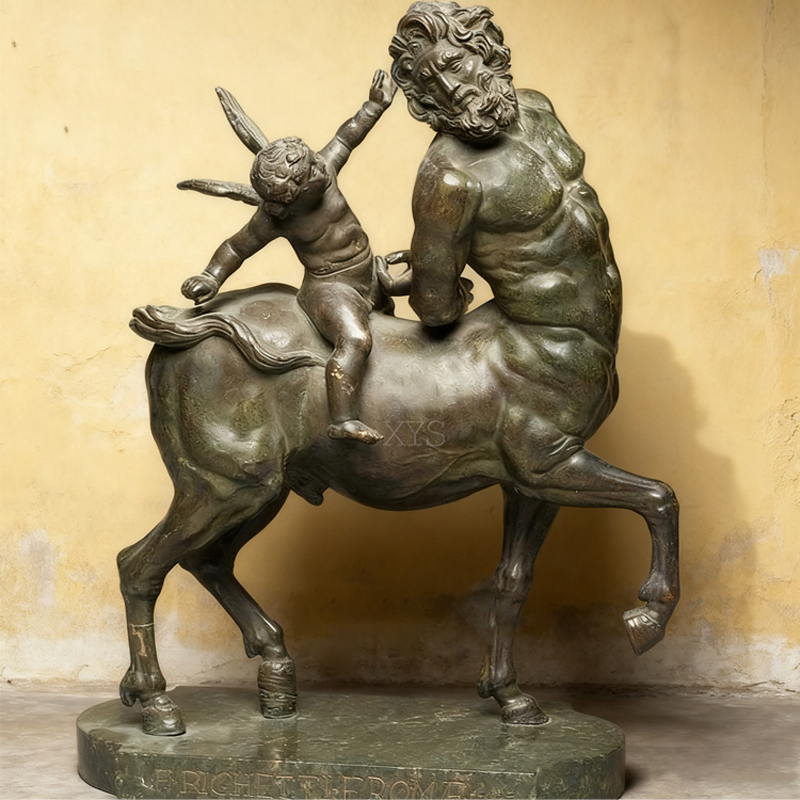 Bronze Centaur and Angel SculptureStanding 1.8 m tall with a blue-green patina, this bronze pairing of a muscular centaur and playful winged cherub echoes the off-balance, upward-reaching energy of Bernini's dynamic mythological groups.View Product →
Gian Lorenzo Bernini (1598 to 1680) defined the style the way a composer defines a school. Before he turned thirty he had carved the Pluto and Proserpina and Apollo and Daphne groups for Cardinal Scipione Borghese, and their surface realism still unsettles visitors: stone flesh that dents under a grip, marble rope that strains. By tradition, his David carries the sculptor's own grimace, worked on while Maffeo Barberini held a mirror.
His mature works pushed the fusion of the arts further. The Ecstasy of Saint Teresa in the Cornaro Chapel stages its light from a concealed window behind gilded rays. Saint Longinus in Saint Peter's Basilica (completed 1638) turns a soldier's conversion into a rotating composition meant to be read while walking. The Fountain of the Four Rivers in Piazza Navona (1651) set colossal river gods on a travertine rock beneath an obelisk, with water animating the entire ensemble.
Rome was never a one-man show. Stefano Maderno's Santa Cecilia (1600) opened the century with haunting prone naturalism. Francesco Mochi's Saint Veronica (completed 1639) whipped drapery into a gale that no one matched for decades. Alessandro Algardi offered a restrained, classicizing alternative prized by papal patrons, while Francois Duquesnoy brought Flemish clarity. The variety matters: baroque was always a family of solutions, not a single formula.
Within two generations the same vocabulary had adapted to very different climates of taste and belief:
| Region | Leading figures | Distinctive local character |
|---|---|---|
| France | Pierre Puget, Antoine Coysevox | Classicism tempered the drama; Versailles gardens used marble groups and fountains as staged scenery. |
| Southern Netherlands | Artus Quellinus the Elder, Lucas Faydherbe | High-relief church decoration and Amsterdam town hall reliefs with muscular emotion close to Rubens's painting. |
| Dutch Republic | Rombout Verhulst | A restrained, classical reading in which baroque rhetoric stayed largely confined to tombs. |
| England | Grinling Gibbons and monument workshops | Funerary effigies and limewood carving, with theatricality filtered through aristocratic restraint. |
| Spain | Gregorio Fernandez, Juan Martinez Montanes | Polychrome wooden processional pasos with glass eyes and cork-built wounds, carried through streets during Holy Week. |
| Latin America | Quito School workshops | Iberian models rebuilt in local timber and pigments, producing some of the most emotionally direct religious figures anywhere. |
| Germany and Austria | Egid Quirin Asam and the Asam family | Altars, stucco, and architecture fused into dizzying wholes, shading into the Rococo by mid-century. |
The Spanish and Latin American branches deserve special note: these figures were not white stone but painted wood, often dressed in real textiles, and their realism served processional performance rather than museum display. Finish, in other words, has always been defined by use.
Baroque marble carving is a controlled fight with the material's weakness, which is tension. Drill channels let deep shadow into drapery folds, and contrast between polished skin and roughly toothed stone pushes figures forward, so a single figure can carry several grades of finish. For today's buyers the lesson is practical: deep undercutting raises cost and fragility, so it should be specified where the eye will travel, not everywhere. The way studios now balance hand skill against modern enlargement and replication methods is exactly what separates an accurate classical figure from a stiff copy, as explained in this look at how marble human sculptures fuse traditional craftsmanship with modern technique.
Sea gods and wind-blown deities remain the natural test cases for this carving, which is why a straining Poseidon still reads as baroque even in a modern courtyard:
Poseidon-themed marble sculpture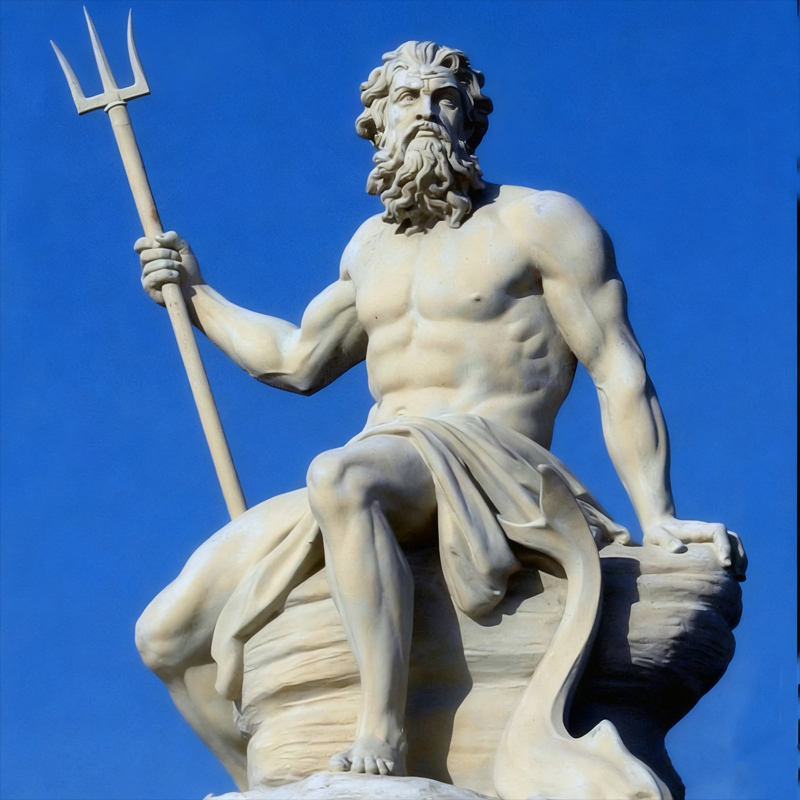 Poseidon-Themed Marble Human SculptureRoughly 1.8–2.5 m tall with trident and flowing drapery, this weather-resistant Poseidon statue shows why bronze-era sea-god compositions still read as baroque power in a modern courtyard or beside water.View Product →
Lost-wax casting freed sculptors from stone's structural logic. Thin airborne drapery, rearing horses, and fully undercut torsos that would shatter in marble are routine in bronze, which is why so many of the era's most extreme compositions, fountains above all, ended up cast. Casting adds mold-making, chasing, and patina stages, and each one is a quality gate. If you are weighing the two metals for a commission, a survey of bronze sculpture types and techniques is a sensible place to start.
Stucco, terracotta, and painted wood carried the rest of the tradition, from Bavarian vault angels to Quito saints, always bridged by a full-size model approved before the final material was touched.
You do not need a papal budget to use this vocabulary. The clients who get the most from baroque-derived work share three habits:
A carved European white marble fountain is the direct descendant of that tradition, and it shows how figure work, basin geometry, and hydraulics must be solved as one contract:
European white marble fountain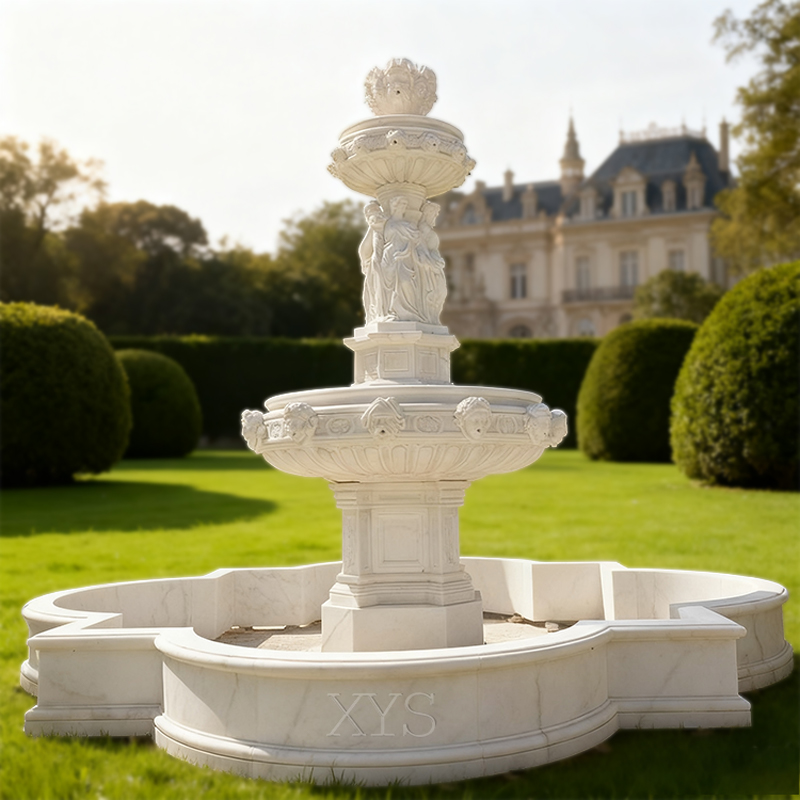 European White Marble FountainCarved from a single block of white marble and standing 3.0–4.0 m, this fountain unites figure work, basin geometry, and flowing water, continuing the baroque tradition of integrated sculptural design.View Product →
When you brief a manufacturer, press on the points that baroque pieces stress hardest: how undercuts and cantilevers are reinforced, how the model is approved before carving or casting begins, which finish levels you will receive, how pieces are split and crated for shipping, and who anchors and levels the work on site. A workshop that answers those questions with drawings and references, rather than adjectives, is the one that can deliver a composition built on tension and keep it standing for decades.
Baroque sculpture endures because it solves a permanent problem: how to make inert material feel alive at the exact moment attention is won. The diagonals, the whipped drapery, and the fused fountain-and-figure ensembles were engineering answers as much as artistic ones, which is why they transfer so cleanly to modern church projects, estate gardens, and public plazas. Choose the material for the setting, plan the viewer's movement, and put water where it belongs in the story, and the seventeenth century will still work as hard for your project as it once did for Rome.



Daniel H.

Amanda R.

Robert B.

Jennifer S.

James W.

Barry G.

Michael T.

Emily K.

David L.

Sarah M.


Mikey XV

Jagxue

 English
 Español
 عربى
عربى Français
 italiano
 Deutsch