Stand in front of the marble David in Florence's Museo Nazionale del Bargello and the first thing that strikes you is how quiet he is. There is no swagger, no trophy, no theatrical pose — just a young shepherd in a long robe, a stone resting in one hand, his eyes lowered as though he is still working out what comes next.
Donatello carved this figure between 1408 and 1409, while he was still in his early twenties. It is the earliest of the celebrated Davids of the Renaissance, and for anyone who has ever stood beside a block of stone and wondered where to begin, it is also the most instructive.
Content
Before the interpretation, the facts. A quick reference helps when you are reading a catalogue, planning a study visit, or simply trying to keep the three Bargello Davids straight in your head.
Two things surprise visitors seeing it for the first time. The scale is modest — a little over life-size, close enough to look a standing person in the eye. And the figure is fully dressed. After Michelangelo, we expect a nude colossus; Donatello gives us a robed adolescent with a stone in his hand and no sword anywhere in sight.
The David was never intended for a museum hall. It was commissioned as part of the decoration programme for the tribunes of Florence Cathedral, one of a series of figures meant to sit high on the exterior, glimpsed from the piazza far below. That context explains a great deal about how the statue is built: the drapery is broad and legible, the silhouette reads at a distance, and the carving is confident rather than fussy.
It was also never hoisted into place. Writers have argued for generations about why — the figure may have seemed too small for its intended height, the buttress programme may have changed, or practical questions about fixing a marble block to the fabric of the building may have intervened. Whatever the reason, the statue stayed on the ground.
In 1416 the Signoria acquired it and placed it in the Palazzo Vecchio, where it became a civic image rather than a sacred one. A Latin inscription was added to the base, praising those who fight bravely for their homeland and promising divine aid against the most terrible enemies. It was a pointed reading of the shepherd boy: not a saint, but a citizen. Later the figure moved to the Bargello, where it now keeps company with Donatello's bronze David and Verrocchio's bronze David — three answers to the same question, made within seventy years of one another.
The stance is restrained. The weight settles onto one leg while the other relaxes, producing a soft, early contrapposto rather than a dramatic twist. The body turns slightly inside the robe, and the shoulders answer the hips. It is a pose built for calm, not for action.
This is where the carving really shows off. A heavy mantle falls over a long tunic, with deep, drilled channels separating the folds and creating pockets of shadow that make the marble look soft. Look at the hem and the sleeve: the edges are cut thin and undercut, a technique that gives stone the weight of cloth but leaves vulnerable projections that a carver has to plan for from the very first roughing-out pass.
David holds the stone; the sling is present but understated. There is no sword and no severed head. The victory is implied rather than displayed, and the downward gaze turns the moment inward. Some studies have noted traces of surface finishing, including gilding in the hair and details, which reminds us that ancient and Renaissance marble was rarely the pure white we now see in galleries.
Placing the four best-known Davids side by side makes the marble version's choices clearer. The table below is a rough orientation, not a substitute for seeing them.
| Work | Date | Material | Height | Defining detail |
|---|---|---|---|---|
| Donatello, marble David | 1408–1409 | White marble | About 191 cm | Clothed, reflective, stone in hand, no head |
| Donatello, bronze David | c. 1440s | Bronze | About 158 cm | Nude but for hat and boots, Goliath's head underfoot |
| Verrocchio, bronze David | c. 1470s | Bronze | About 158 cm with base | Slim, lightly armoured youth with sword and head |
| Michelangelo, David | 1501–1504 | White marble | About 517 cm | Colossal nude, sling across the back, before the fight |
Working in marble teaches you to respect a plan. The Bargello David is a masterclass in anticipating risk: the thin wrist, the undercut hem, the slender neck. Every one of those passages had to be roughed out in sequence, so that the stone was never unsupported while a neighbouring area was being removed. Our own carvers still talk about this when a client asks for a classical figure with flowing drapery — the conversation always comes back to how much material can safely be taken away, and in what order.
The finish matters just as much. Donatello's surface is worked, not simply smoothed; chisel marks and subtle tonal variation keep the marble alive under gallery lighting. That is one reason we still argue for hand finishing on classical commissions rather than a uniformly polished skin. If you would like to read more about how traditional carving practice and contemporary production are combined, our article on how marble human sculptures fuse traditional craftsmanship with modern methods goes into the workshop side of it.
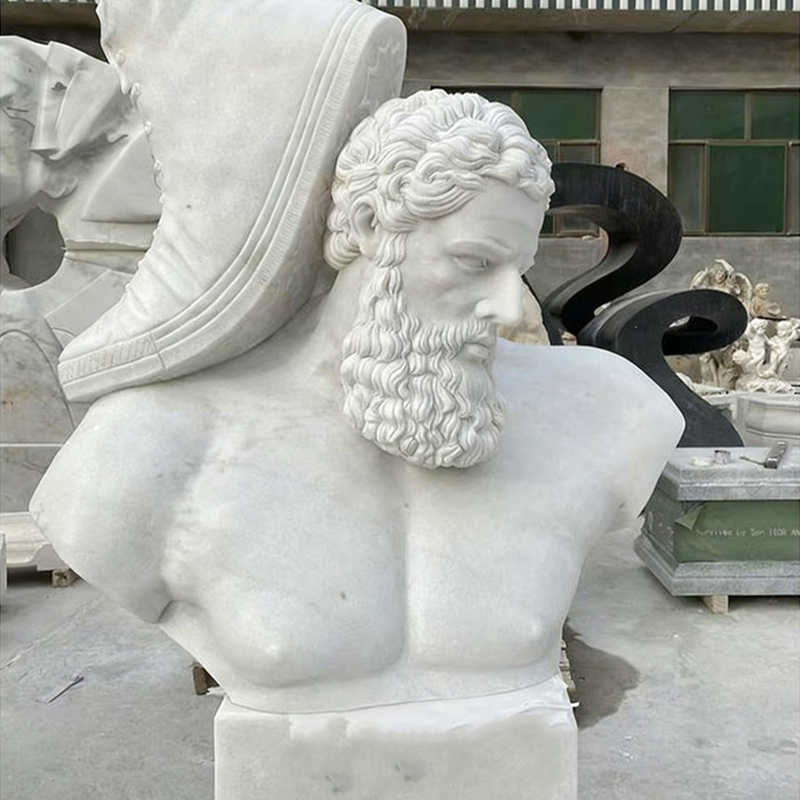 Hand-Carved Marble Bust with Contemporary Sneaker AccentsClassical bust meets streetwear through hand-carved marble and sneaker details, offering a light-responsive focal point for art spaces or luxury interiors.View Product →
Most of the people who come to us after falling for the Bargello David are not asking for a copy. They are asking for the same qualities: a figure that reads clearly from a distance, drapery with genuine depth, and a surface that responds to light instead of flattening under it.
In practice that means a conversation about scale and setting first. An indoor bust or a garden figure at three-quarter life-size will be carved and finished quite differently from a courtyard piece seen from twenty metres away. It also means choosing the block carefully — veining, colour and internal soundness decide a great deal about what the finished piece can be. We usually recommend working through a maquette before any roughing-out begins, and for classical projects we keep a library of reference photographs and measured drawings on hand so that proportions stay honest.
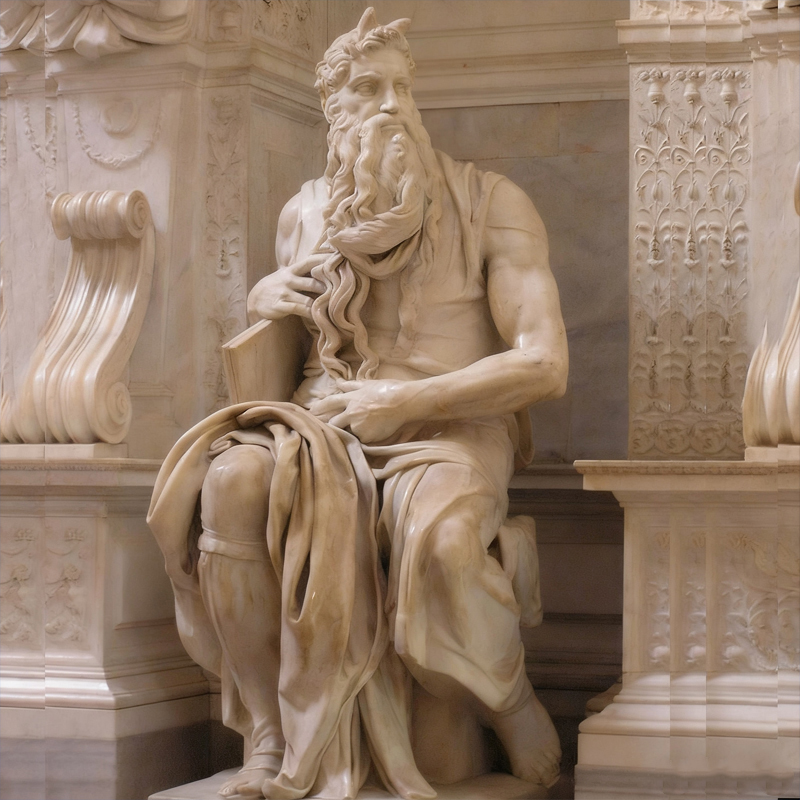 Classical Seated Marble Statue with ScrollRenaissance-inspired seated figure in natural marble, with robe folds and scroll, suited as a historical focal point for churches, museums or private spaces.View Product →
If you already know roughly what you want, browsing our marble human sculpture collection is a quick way to establish a starting point for size, pose and finish before we talk specifics.
Donatello's marble David rewards the kind of looking that a photograph cannot support. The next time you are in Florence, give it fifteen minutes rather than fifteen seconds: walk around it, watch how the folds change as you move, and notice how much of the story is told by a lowered gaze and a single stone. It is a young man's sculpture made by a young man, and it still shows what patience with a block of marble can produce.



Daniel H.

Amanda R.

Robert B.

Jennifer S.

James W.

Barry G.

Michael T.

Emily K.

David L.

Sarah M.


Mikey XV

Jagxue

 English
 Español
 عربى
 Français
 italiano
 Deutsch