People rarely ask who cast a famous bronze statue. They ask what it means, why it stops them in a crowded square, and why it looks as though it has always been there. Bronze has a way of turning a moment in history into something permanent, and the statues we remember most share that quiet authority. After more than a decade of casting, carving, and installing sculpture for clients on four continents, we have learned that famous bronzes are never accidents. They come from good material, patient craft, and a story worth telling.
Content
Bronze is an alloy of copper and tin, and it happens to be one of the friendliest metals a sculptor can work with. It melts at a temperature a foundry can manage, flows into the finest crevices of a mold, and hardens into something strong enough to stand outdoors for centuries. An artist can model a strand of hair, the fold of a cloak, or the tension in a horse's neck and trust the metal to carry that detail through casting.
Then there is what time does to it. Left outside, bronze slowly develops a patina: the brown, near-black, or soft green surface layer that forms as the metal reacts with air and moisture. That layer is not damage. It protects the metal beneath and gives the surface a depth that paint can only imitate.
Perhaps the most telling fact about bronze is how much of it has vanished. For centuries statues were melted down for coins, cannons, and church bells whenever a city needed metal more than it needed art. The ancient bronzes that survived did so against long odds, which is part of why each one still feels like a small miracle.
The list below is not a ranking. It is a short tour of works that shaped how the world thinks about bronze, gathered from four continents and nearly two thousand years of casting.
| Statue | Artist and Date | Location | Why It Is Remembered |
|---|---|---|---|
| Perseus with the Head of Medusa | Benvenuto Cellini, 1545-1554 | Loggia dei Lanzi, Florence | A Renaissance casting triumph that proved bronze could match marble in grace |
| Equestrian Statue of Marcus Aurelius | Unknown, about 175 AD | Capitoline Museums, Rome | The only equestrian bronze of a Roman emperor to survive antiquity |
| The Great Buddha of Kamakura | Kamakura casters, 1252 | Kotoku-in, Kamakura, Japan | A monumental seated Amida Buddha that has weathered the open air for centuries |
| The Thinker | Auguste Rodin, 1880-1904 | Musee Rodin, Paris, with casts worldwide | The seated figure that became the most recognizable image in modern sculpture |
| The Little Mermaid | Edvard Eriksen, 1913 | Copenhagen harbor | A small, human-scale figure that grew into a national symbol |
| Charging Bull | Arturo Di Modica, 1989 | Bowling Green, New York City | Installed overnight without permission and adopted by the city anyway |
Two traditions stand out when you walk past these works. The first is the equestrian monument, the bronze rider on a horse that has carried the memory of rulers, generals, and hometown heroes since antiquity. The Marcus Aurelius statue survived largely because medieval Rome believed it portrayed the Christian emperor Constantine, and the mistake saved it from the furnace.
The second tradition is the single figure caught mid-thought or mid-step. That is where Rodin changed everything. His thinker is not a portrait of anyone in particular, which is exactly why so many cities, campuses, and collectors have wanted a version of that pose on their own ground.
Fame is not a material property, but the statues that last tend to share a handful of practical qualities.
Pose carries more weight than most people expect. A seated figure with a hand near the chin invites the viewer to think along with it, while an open, rising gesture pulls attention upward and outward. When clients ask us why a sculpture they saw abroad felt so powerful, the answer is usually a quiet one: the pose and the scale were chosen together, before a single pound of metal was melted.
Nearly every famous bronze statue you can name was made the same way, give or take a few shortcuts. The lost-wax method has barely changed in principle since antiquity.
Each stage can add weeks to a project, which is why a large commission usually takes several months from approval to installation. It also explains why two statues of the same subject from different workshops can feel worlds apart: the difference is in the chasing, the welding, and the patience applied to the surface.
Most of the bronze work leaving our workshop is not destined for a museum. It is made for a town square, a university garden, a memorial grove, or a family courtyard, and the process is far more approachable than people expect. A few decisions settle most of the questions early.
If the subject is a real person, a portrait sculpture is usually the right starting point. It is one of the most demanding things a foundry can take on, because a face has to hold up to lifelong scrutiny from people who knew it well.
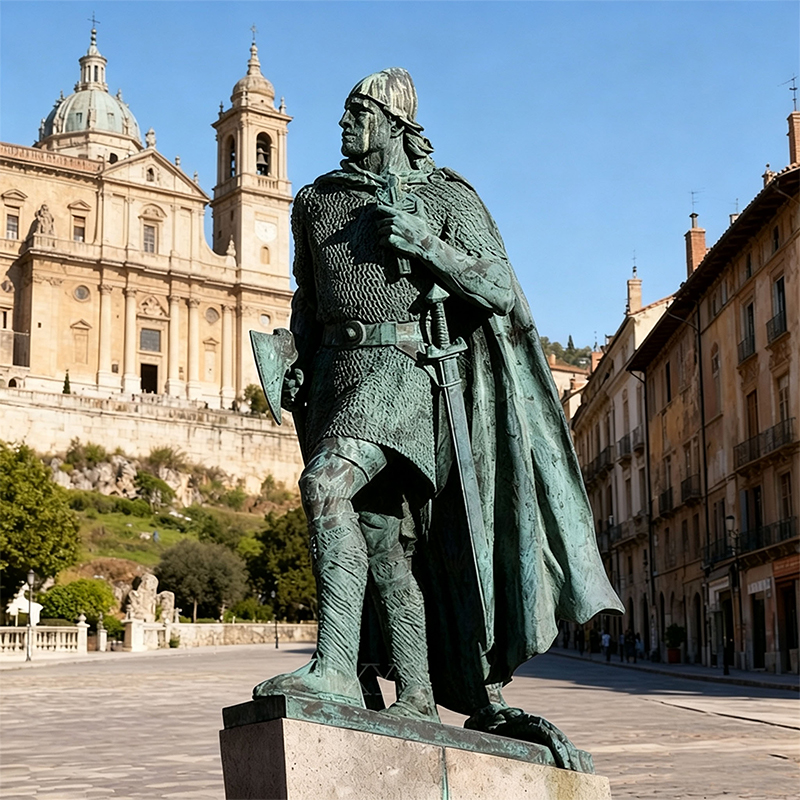
Bronze is forgiving, but not indifferent. Outdoor pieces benefit from a simple routine that keeps the patina even and the surface clean.
Handled this way, a bronze statue quietly outlives the people who commissioned it, which is really the whole point.
Whether you are studying the world's famous bronze statues or planning one of your own, the same three things decide the outcome: a strong idea, a well-cast form, and a surface finished with care. If you are still weighing materials and casting options, our guide to bronze sculpture types, techniques, and how to choose the right one is a practical place to start. When you are ready to talk through a specific project, our team is happy to walk you through it, from first sketch to the day the crane leaves your site.



Daniel H.

Amanda R.

Robert B.

Jennifer S.

James W.

Barry G.

Michael T.

Emily K.

David L.

Sarah M.


Mikey XV

Jagxue

 English
 Español
 عربى
 Français
 italiano
 Deutsch