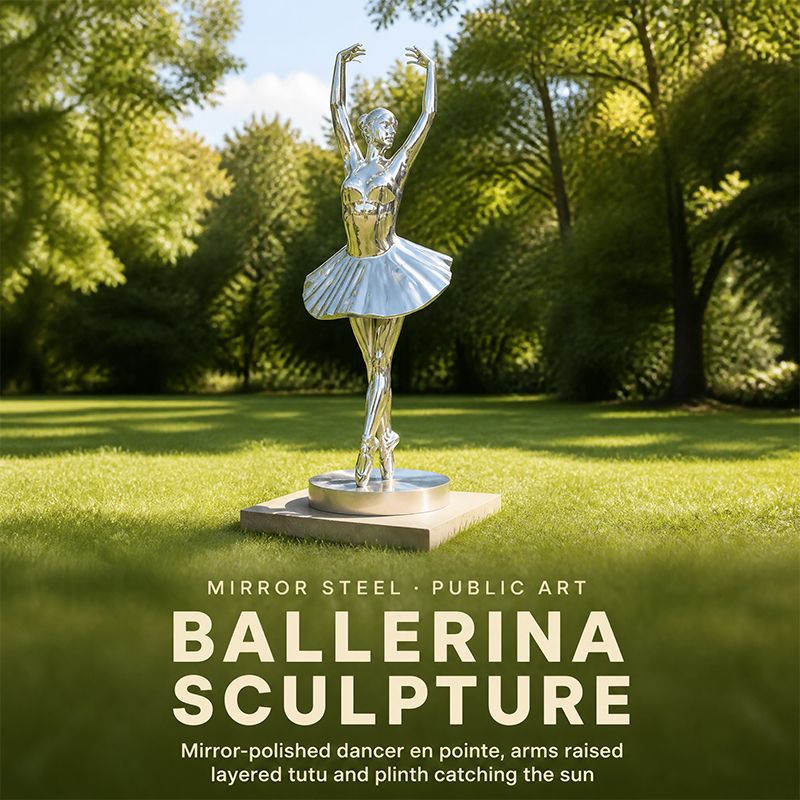
Content
Stainless steel has carved out a dominant position in modern art for reasons that go far beyond mere aesthetics. At its core, the material offers a rare combination of physical properties that few other mediums can match. Its high chromium content — typically between 10.5% and 30% — creates a passive oxide layer on the surface that resists corrosion, rust, and environmental degradation. For outdoor sculptures exposed to rain, humidity, extreme temperatures, and pollution, this durability is not a luxury but a necessity. Artists and commissioners alike know that a stainless steel sculpture installed in a public park today will still gleam decades from now with minimal maintenance.
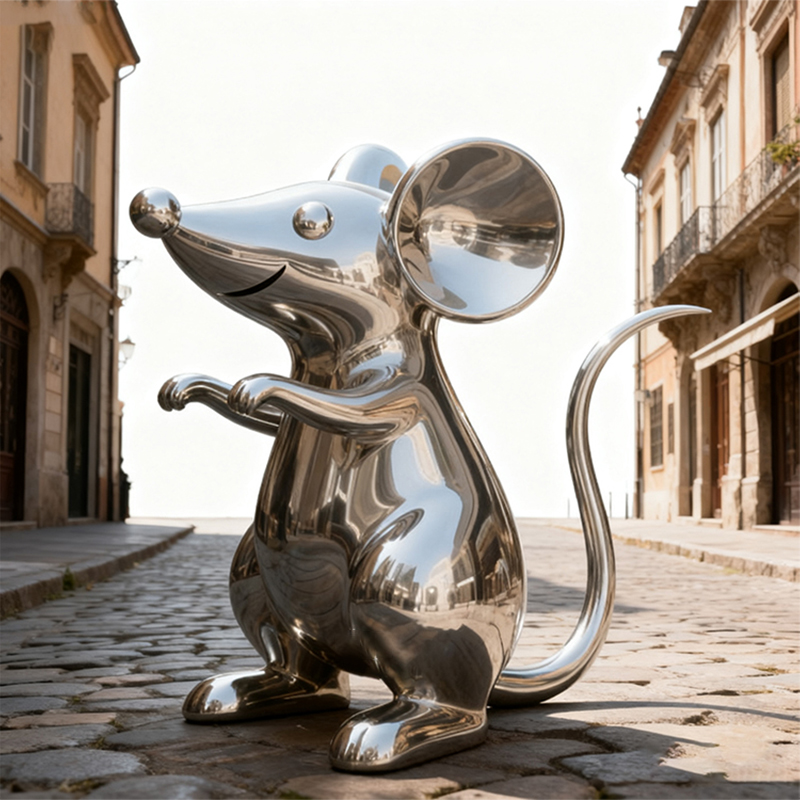
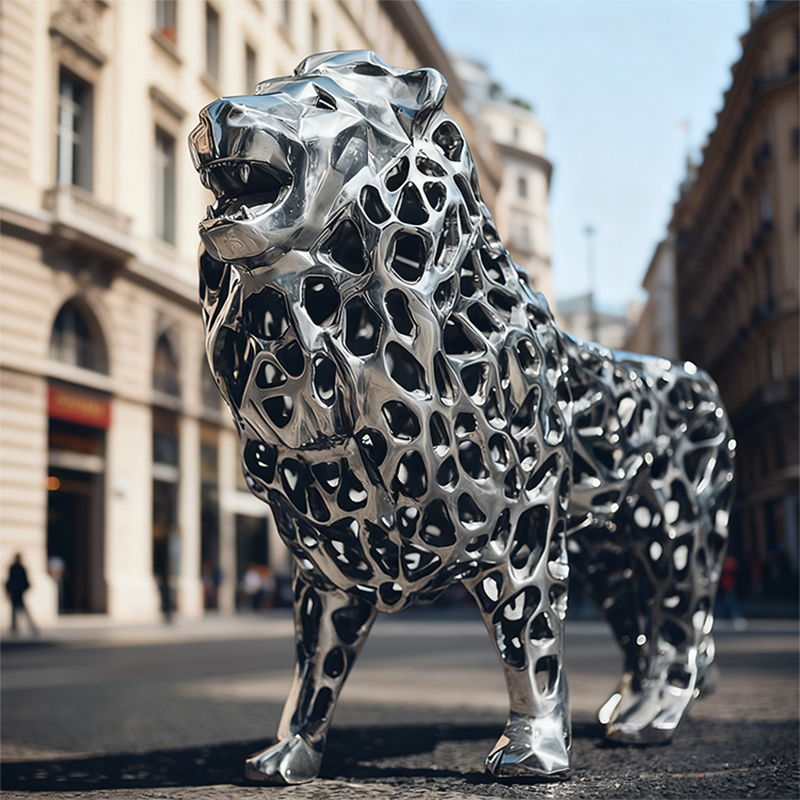
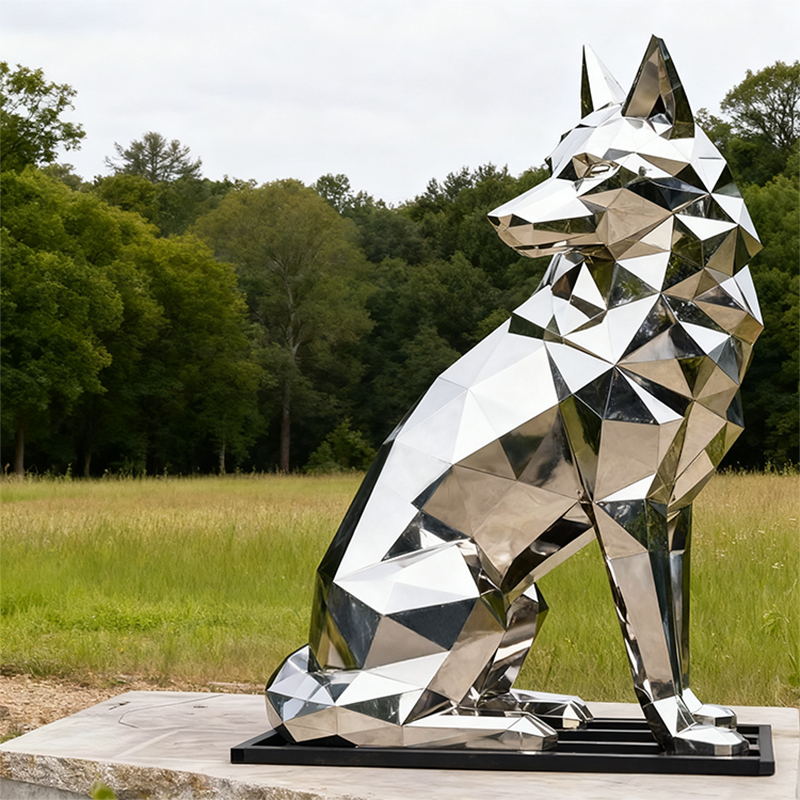
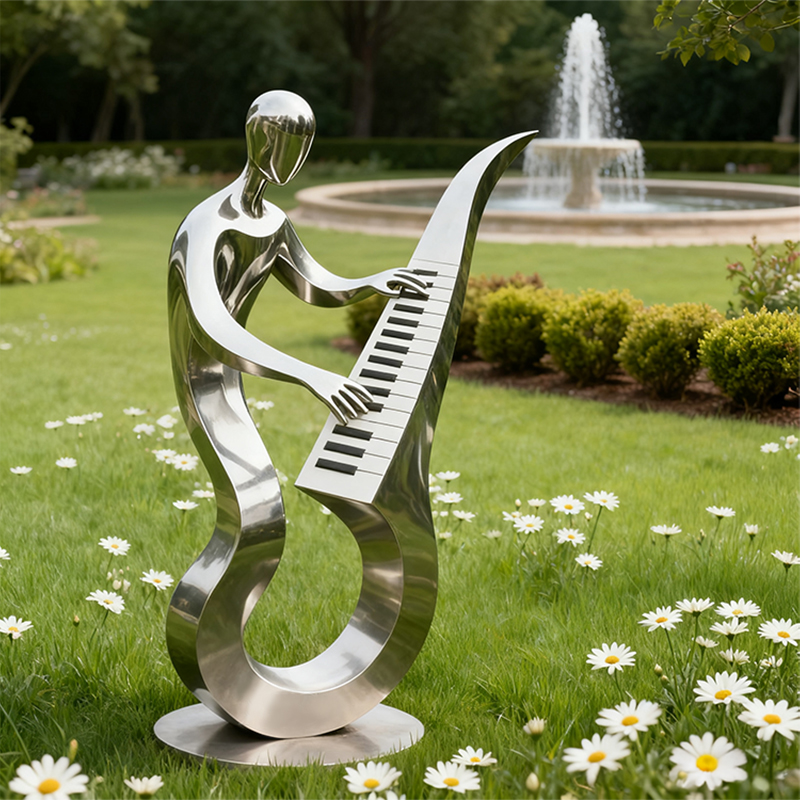
Beyond durability, stainless steel offers exceptional workability. It can be cast, welded, polished, brushed, hammered, and shaped into virtually any form the artist imagines — from sweeping organic curves to razor-sharp geometric planes. The material holds fine detail well and responds beautifully to post-processing treatments. Artists can choose between a mirror-polished finish that reflects the surrounding environment like a living painting, a matte brushed surface that absorbs and diffuses light softly, or a textured finish that plays with shadow and depth. This versatility makes stainless steel one of the most expressive structural materials available to contemporary sculptors.
One of the most powerful and distinctive features of polished stainless steel is its mirror-like reflectivity. Unlike traditional sculpture materials such as bronze or marble, which present a static visual surface, mirror-polished stainless steel is constantly changing. It reflects clouds, pedestrians, surrounding architecture, shifting light throughout the day, and even the viewer's own distorted image. This turns the sculpture into an active participant in its environment rather than a passive object within it.
Perhaps no artist has exploited this quality more famously than Anish Kapoor with his monumental work Cloud Gate (2006) in Chicago's Millennium Park. Affectionately nicknamed "The Bean," the sculpture's seamless polished surface warps and reflects the city skyline and everyone who stands before it. Visitors are drawn to interact with it, walking beneath it and watching their reflections stretch and distort. This interactivity — made possible entirely by the material's reflectivity — elevates the work from static art object to communal experience. Reflectivity in stainless steel effectively makes the audience part of the artwork itself.
Municipal governments, private developers, and cultural institutions that commission large-scale public art consistently turn to stainless steel for practical reasons that align with financial responsibility and long-term planning. When a city installs a major sculpture, it expects that work to represent the community for generations. Stainless steel meets this expectation in ways that are hard to argue against.
These practical advantages make stainless steel the responsible choice for institutions that must balance artistic vision with fiduciary duty to taxpayers and stakeholders.
To understand why stainless steel has risen to such prominence, it helps to compare it directly with the materials it has largely displaced or supplemented in contemporary sculpture practice.
| Material | Durability | Maintenance | Visual Effect | Cost |
| Stainless Steel | Excellent | Very Low | Reflective, Dynamic | Medium-High |
| Bronze | Good | Moderate | Warm, Traditional | High |
| Marble / Stone | Moderate | High | Classical, Static | Very High |
| Corten Steel | Good | Low | Rustic, Earthy | Medium |
| Aluminum | Good | Low | Light, Modern | Medium |
The table illustrates that while no single material is universally superior, stainless steel occupies a uniquely balanced position — offering longevity, minimal upkeep, and a visual language that feels unmistakably contemporary.
There is something inherently forward-looking about stainless steel that resonates deeply with the values of modern and contemporary art. The material carries cultural associations with technology, industry, precision, and progress. When artists choose stainless steel, they are not simply selecting a substrate — they are making a statement about the time in which they live and the world they are responding to. Unlike marble, which evokes antiquity and classical ideals, or bronze, which speaks to historical permanence and tradition, stainless steel belongs unmistakably to the present.
This alignment with modernity has made stainless steel a natural medium for artists exploring themes of globalization, technological acceleration, consumer culture, and environmental change. Jeff Koons, one of the most commercially successful and critically provocative artists of the late 20th and early 21st centuries, built much of his career on highly polished stainless steel works that reference mass-produced consumer objects — balloon animals, toys, and advertising imagery — rendered at monumental scale in an industrial material. The tension between the cheerful subject matter and the cold, flawless precision of the steel surface creates a dissonance that has sparked decades of critical debate. That provocation is only possible because of the specific cultural meanings the material carries.
The rise of stainless steel sculpture has been inseparable from advances in fabrication technology. In earlier eras, working with steel on a large scale required enormous physical effort and significant limitations in achievable form. Today, computer-aided design (CAD) software allows artists to model complex three-dimensional shapes with extraordinary precision, while CNC (computer numerical control) cutting and bending machines can translate those digital designs into physical reality with tolerances measured in fractions of a millimeter.
These technologies have effectively removed many of the practical barriers between an artist's imagination and physical realization. Sculptures that would have been technically impossible or financially prohibitive a generation ago are now achievable, and this expansion of creative possibility has attracted more artists to the medium than ever before.
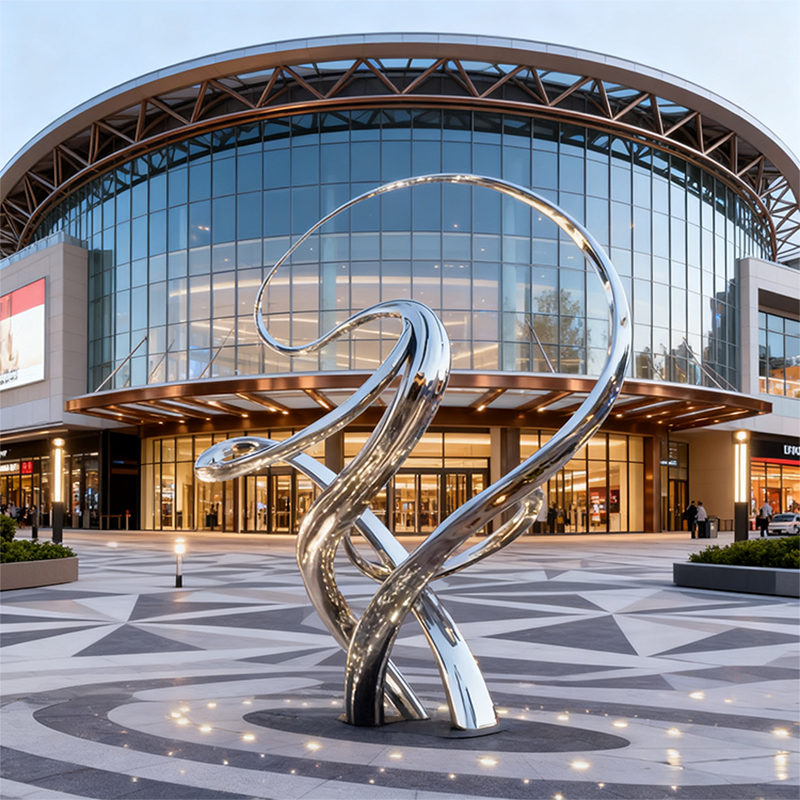
The prestige of stainless steel sculpture has been built not just by individual artists but by a series of landmark installations that have captured global attention and become cultural touchstones. These works demonstrate the full range of what the material can achieve when artistic vision meets technical excellence.
Cloud Gate by Anish Kapoor in Chicago remains the most visited public sculpture in the United States, attracting millions of visitors annually and generating substantial economic activity for the surrounding area. In South Korea, the Gimhae Gaya Theme Park features a series of stainless steel warrior figures that merge historical cultural imagery with contemporary fabrication techniques. In Europe, numerous city centers have commissioned abstract stainless steel works as centerpieces of urban renewal projects, using the sculptures' reflective surfaces to visually connect new public spaces with their surroundings. In the Middle East, rapidly developing cities like Dubai and Abu Dhabi have embraced large-scale stainless steel installations as symbols of modernization and international cultural aspiration.
Each of these examples reinforces a self-sustaining cycle: major commissions attract media coverage, media coverage builds public familiarity and affection for the material, and that cultural familiarity encourages more institutions to commission stainless steel works. The material's prominence in modern art is not accidental — it is the cumulative result of individual artistic decisions, institutional choices, and technological progress compounding over decades.
Stainless steel sculptures have become so prevalent in modern art because the material itself is uniquely suited to express the values, aesthetics, and ambitions of contemporary culture. Its physical properties — durability, workability, and reflectivity — give artists extraordinary creative freedom. Its cultural associations with technology and progress make it a natural vehicle for commentary on modern life. Its practical advantages make it the responsible choice for institutions commissioning work that must serve communities for generations. And the ongoing development of fabrication technologies continues to push the boundaries of what is formally possible.
As cities continue to invest in public art, and as artists continue to push the limits of large-scale three-dimensional work, stainless steel's centrality in modern sculpture is likely to endure and deepen. It is not merely a fashionable choice — it is a material that has earned its prominence by delivering on every dimension that matters to artists, institutions, and audiences alike.



Daniel H.

Amanda R.

Robert B.

Jennifer S.

James W.

Barry G.

Michael T.

Emily K.

David L.

Sarah M.


Mikey XV

Jagxue

 English
 Español
 عربى
عربى Français
 italiano
 Deutsch